JSGeneticNeuralNetwork.js experiment

This new project is about feed forward neural network with genetic evolving weights. I’ve combined my two libraries, JSGenetic and JSNeuralNetwork, plus a little module I’ve developed about continuous genetic algorithms, and developed a little library which evolves neural networks with a genetic algorithm.

A little example I’ve made to test the library can be found here, it’s pacman learning to eat.

There are also other examples in the JSNeuralNetwork page.

QuiXXX down, quick and hopefully effective primitive load balancing system

QuiXXX, an app for android and windows phone me and a friend developed some time ago, was actually (and unbelievably) doing well. It has been receiving ~ 5 to 10 thousands visits per month, which was about 5-10k times more than we expected when we first developed it as a joke.

Anyway, recently there has been a peek in traffic (looks like mexican windows phone users liked the app) and we first noticed the problem: we are exceeding the maximum CPU load of our free hosting service (frogcp.com):

cpuexceededfrogcp

So I registered another free account on altervista.org and uploded the app there, then also mirrored the app on my domain www.nicassio.it, and wrote a very primitive load balancing redirect in php to be hosted on the original service frogcp, which redirects to one of the two mirrors with equal probability.

Let’s see if this will sort it out.

Ah, this broke the scoreboard, but this is temporary.

I’ll update this blog post when there’s further information.

[update]

We needed to do this without an actual update of the app, but this is not possibile, at least for android. Any page on a different domain will be opened in the browser, instead of within the app. That’s because we didn’t tell the app to handle redirection that way. Since we are not willing to release an updated version of the app right now, after being ublocked today I reuploaded the app to the original frogcp url making some changes to lower the cpu usage. I hope this will be enough for the near future.

Naive Bayes Classifier in JS, empowering telegram webapp

Today I made a simple implementation of a naive bayes classifier in Javascript. The implementation was largely inspired by this article.

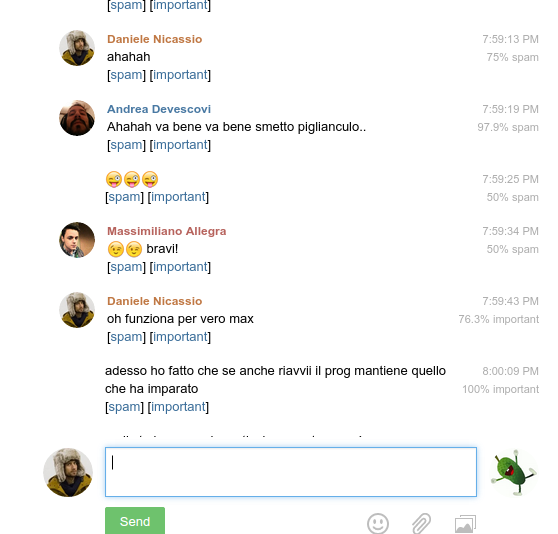
After that, I spent some time to integrate it with this Telegram webapp, and now I have a telegram webapp in which you can mark messages as ‘spam’ or ‘important’, and every message is then classified giving some confidence about the possibility of it of being part of these categories.

It saves the results to the chrome local storage, so that you can train the classifier over time, preserving the results beetween sessions.

When I will train it enough, and if the results are good, I’m looking forward to implement the auto-hiding of messages based on this data. This is intended for large telegram group chats, in which often off-topic messages will just make painful extracting important messages from the enormous amount of things people texted. How many times you look at your preferred messaging app and you find ~50 unread messages? This is meant to resolve this, even if the bayes classifier is not perfect for this task, it was easy to implement and usually gets good results. I’ll update here if I have encouraging result from this test.

Meanwhile, here’s a screenshot:

telegrambayesscreenshot

JSNeuralNetwork updates and some more experiments

I’ve updated the JSNeuralNetwork library implementing a small and still simple version of the Hopfield Network, along with some implementations.

Moreover, I implemented a new experiment based on the Kohonen networks, which is about vision, and needs a webcam to work.


As usual everything is here: http://www.nicassio.it/daniele/JSNeuralNetwork/.

Due parole e un’app sugli strani redirect sdc.tre.it sdcf.tre.it di Tre Italia

In questi giorni mi sono ritrovato a discutere con i centralinisti del servizio clienti di Tre Italia a proposito di strani redirect che mi succedevano navigando su rete 3 con il mio cellulare. In particolare, succedeva che il mio browser veniva a tutti gli effetti intercettato e rediretto ad un servizio che appartiene al dominio tre.it, el mio caso sdcf.tre.it, che redirigeva a siti pubblicitari.

Ricercando in rete l’indirizzo, ho trovato diverse persone che condividevano il mio stesso problema, così ho deciso di telefonare al servizio clienti per far chiarezza.

La prima telefonata è stata a dir poco futile, nella quale il (non troppo preparato) centralinista mi assicurava che l’indirizzo non aveva assolutamente a che fare con alcun servizio della Tre. La cosa è ovviamente e palesemente falsa, dal momento che è un indirizzo che appartiene al dominio tre.it, registrato dalla società in questione.

A questo punto ho deciso di scrivere sulla pagina facebook di assistenza clienti 3, ottenendo le prime informazioni:

screen_assistenza_tre_sdcf


Insistendo col servizio clienti, un’altra operatrice mi cerca di dare maggiori informazioni, ma nemmeno lei sa spiegare qualcosa a proposito di questi strani redirect. L’unica cosa che scopro è che sul mio conto sono stati addebitati 14 centesimi per visualizzazione di contenuti di “editoria mobile”, che sono riconducibili a testate giornalistiche che hanno stretto contratti con Tre Italia per addebitare automaticamente sul conto dei visitatori che accettassero di visualizzare le pagine con i loro articoli. L’operatrice mi assicura che quando queste pagine si presentano, da qualche parte deve essere specificato che il contenuto è a pagamento, e io di questo sono sicuro. Ma sono anche relativamente certo che non avrei mai accettato di pagare 7 o 9 centesimi per visualizzazione se ne fossi stato cosciente. Sento puzza di soldi facili per le testate giornalistiche e Tre.

Detto questo, chiedo che Tre non accetti mai in futuro addebiti sul mio conto che non siano relativi all’utenza telefonica, come ad esempio questi addebiti da siti quali corriere.it o repubblica.it. L’operatrice insiste che questo non è possibile, farfugliando qualcosa a proposito del fatto che Internet è libera. Devo dire che se anche Internet fosse libera, cosa di cui dubito sempre di più, Tre si sta impegnando in tutti i modi per evitare che sia così.

Finito questo piccolo sfogo, che racconta la mia esperienza con gli addebiti Tre, veniamo alla parte tecnica, che più si addice a questo blog. Ho provato a realizzare un’applicazione Android che, senza necessità dei permessi di root sul telefono, sia in grado di intercettare le chiamate ai servizi di tre.it riconducibili a pubblicità o addebiti indesiderati. Cercando in rete ho scoperto degli indirizzi sono usati da Tre per “servizi” che hanno (a mio avviso) come scopo principale quello di addebitare costi a utenti inconsci, e che si possono trovare preinseriti addirittura nei browser predefiniti dei telefoni brandizzati Tre. Tutto questo è un insulto alla clientela, se non si può già paralare di truffa.

L’applicazione che ho sviluppato serve ad intercettare eventuali redirect indesiderati del browser verso questi indirizzi:

sdc.tre.it

sdcf.tre.it

mobile.tre.it

portal.tre.it

L’applicazione è per ora in fase di test, potrebbe non funzionare bene e non in tutti gli scenari, ma è già qualcosa. L’ho già rilasciata sperando che possa funzionare almeno in parte per chi condivide questi problemi, soprattutto perchè anche cercando in rete, o chiamando il servizio clienti sembra che questi problemi non si possano risolvere altrimenti.

Ecco il link all’applicazione nel Google Play Store:

https://play.google.com/store/apps/details?id=it.nicassio.addebititreblocker

Update:

Aggiungo un link ad un relativo articolo di bastabollette.it che suggerisce anche un approccio legale al problema: https://bastabollette.it/telefonia/h3g/sdcf-tre-come-difendersi/

JSGenetic Curriculum

This is my last experiment: text which creates itself with a genetic algorithm, implemented in JS by my library JSGenetic, which I wrote some time ago and described in a previous post.

I used this kind of self-generating text to implement a timeline based curriculum vitae, of which I’ll have to review the content, but i’m quite happy with the structure.

As you can see when it computes the icons, this doesn’t work only for text, but with with generic pixel templates too.

Here’s the link.

MicroAccounting Web App

This semester at the university I attended a course of web programming, and as part of the final exam I was asked to develop a web application. It would use a Java servlet hosted by the Google App Engine, and would store data to the Google’s Datastore.

I thought that it would be much more useful to make a mobile web app, which is something slightly more challenging which I didn’t practice a lot in the past.

The app goal is to track daily expenses, by providing a way to insert, edit and delete transactions.

Of course the whole project was basically boring (which is different than easy), so I decided to add a funny functionality: I included a QR code scanner to add transactions by automatically, simply scanning the related QR code.

In the end, it has been fun, and as usual I’m writing this blog post to keep track of my works.

A live version of the app is hosted by Google here.

A simple test Microaccounting Store which provides QR codes to test the app is here.